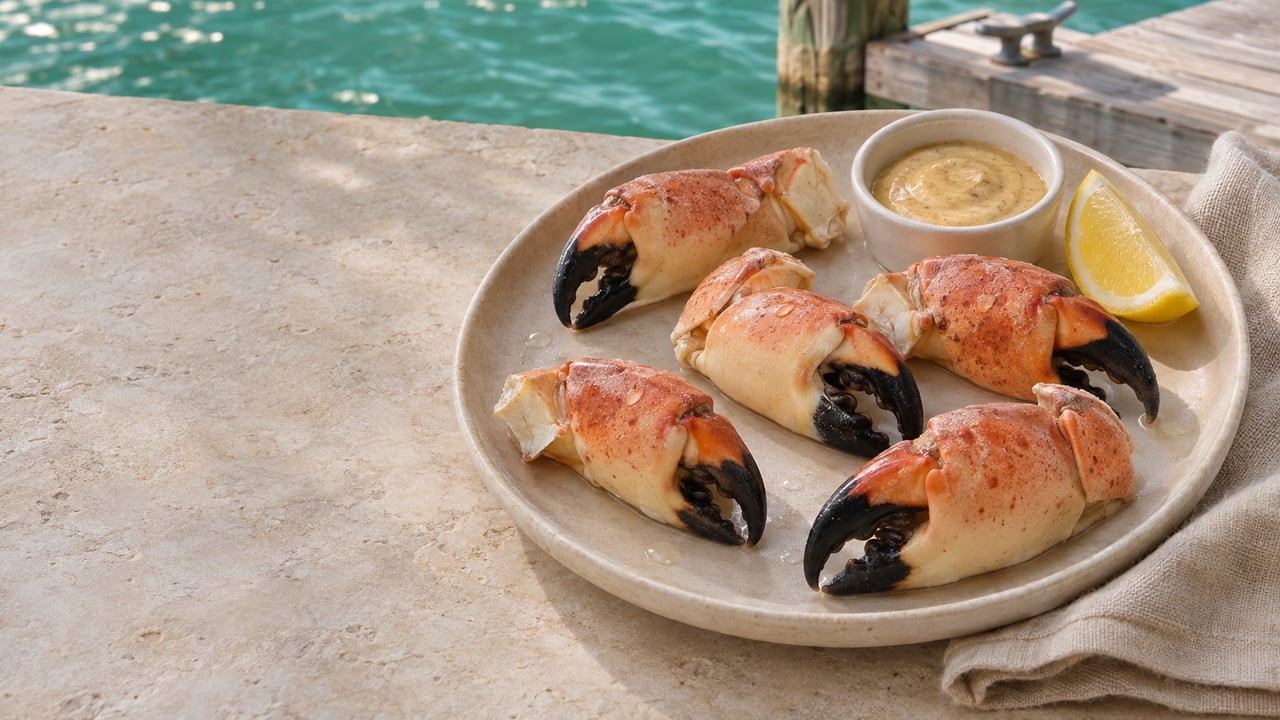
"Hay veces mucho, hay veces poco." Sometimes a lot, sometimes a little. Orestes Cordero said it on the dock behind Keys Fisheries two days before the season opened. Then he gave KeysNews the rest of the explanation: a lot of product means little money, and a little product means a higher price. Cordero has worked that dock for 11 years, first as a worker and now as an owner. He fishes a small license of about 50 traps, a fraction of what the big boats run.
Upstairs at Keys Fisheries, the menu leaves the stone crab price blank. Nearly a month into the 2026–27 season, the price is still set each day by whatever came up in the traps that morning.
The price gets set before sunrise
Stone crab traps went into the water to soak on Oct. 5. Under Florida Fish and Wildlife Conservation Commission rules, nobody could pull them until the opener on Thursday, Oct. 15. Scott Dekle, vice president of Keys Fisheries, told KeysNews that boats leave around 4 a.m. When the traps sit 30 miles out, the crew rides for two hours before reaching the first one. In his words, no one knows the catch until that first trap comes up.
The catch landing on 35th Street matters well beyond Marathon. According to KeysNews, Florida harvests about 2 million pounds of stone crab a year, 40 percent of it comes from the Florida Keys, and Keys Fisheries is the state's largest processor of the claws. Statewide, the stone crab industry brought in $42.3 million in 2024, according to Florida Department of Agriculture and Consumer Services figures cited by the South Florida Sun Sentinel.
This year's first pull came in heavy. The Sun Sentinel reported bountiful opening hauls a week after Hurricane Isaias hit the Gulf Coast. Wholesaler Vinny Morris told the paper that "the storm churned up the seas and moved crabs straight into the traps." His supplier is Billy's Stone Crab, which runs two fisheries in the Keys, one in Summerland Key and one in Marathon.
What the menu at Shannon's leaves blank
Shannon's Crustacean Station is the upstairs tiki bar at Keys Fisheries. Before the opener, bartender Lauren Barbush told KeysNews, "I have no idea what the price is. Especially with the cost of diesel and everything now." Manager Kathy Perez explained why the menu shows no stone crab price. It depends on "how big is the Stone Crab," "how much is the pound" and "the cost of the gas."
Each of those three factors moves on its own. The Sun Sentinel's opening-week survey of South Florida sellers shows how far apart prices landed even with a good haul. Overall, sellers reported strong demand and strong supply, with prices about flat against the start of last season, despite short supplies of medium claws in the first days and high diesel costs.
| Opening week 2026, per pound | Medium | Colossal |
|---|---|---|
| Vinny's Stone Crab & Seafood, delivery with no storefront | $22 | $50 |
| Captain Clay and Sons Seafood Market, Delray Beach | $28.99 | $58.99 |
| Triar Seafood, Hollywood | $39 | $79 |
These are mainland prices from the week of Oct. 19, not Marathon quotes. The medium column shows the point anyway: in the same week, with claws coming from many of the same waters, the gap between the cheapest and most expensive seller was $17 a pound. Triar owner Peter Jarvis blamed part of his price on "the frustrating cost of diesel," which fuels both the crabbing boats and the delivery trucks. Clay Brand Jr. of Captain Clay and Sons said "the medium supply was a bit light," even though his full 400-pound order arrived from the Keys and the Gulf Coast.
A posted price at a Marathon counter is that day's answer to Perez's three questions. Call ahead, and expect a different answer next week.
The calendar inside the season
If the haul sets the daily price, the calendar sets the trend. Fish house operators down the island chain told KeysNews the same story about how the season tends to run:
- Opening day runs late. Dekle said lobster, still in season, gets cooked first thing in the morning, and the crab doesn't come out until later in the day.
- The day after fills the counter. At Keys Fresh Seafood on Stock Island, co-owner Brandon Geide said "everybody gets in late on the 15th," so the 16th is when the counter fills, "because we got to cook them."
- The first pull sets the market. Martin Rahming at Fishbusterz on Stock Island said claws sell at market price and the first haul is "definitely gonna give you a good market price."
- Prices ease, then climb for the holidays. Geide described the pattern within a season: prices are higher at the start when demand peaks, drop later on, and "around Christmas time it shoots back up."
- The season closes May 1. Keys Weekly's season listing gives the dates as Oct. 15, 2026, to May 1, 2027.
Geide also put the bigger picture in perspective. Claw prices spiked hard around COVID-19, he said, and have been "slowly coming back to that normal" since.
The rules the dock asked for
Part of what keeps supply tight is a set of rules fishermen helped write. Dekle told KeysNews that the 2020 changes came out of structured meetings between organized fishermen and state staff, because "our catch keeps going down." He listed three changes. The minimum claw size grew by an eighth of an inch, to 2 7/8 inches. Traps now need an escape ring so small crabs wash out when a trap comes up. And the season lost two weeks in May, after a state biologist told him that more than half of female crabs carry eggs in the first half of that month.
The FWC's recreational stone crab page lists the state-waters season as open Oct. 15 through May 1, sets the minimum claw size at 2 7/8 inches, allows claws only, and prohibits taking claws from egg-bearing crabs. Anyone with traps of their own should read the full rules on that page. This post is general information, not legal advice. The crab goes back in the water and grows its claws back, and Dekle said scientists expected the 2020 changes to take six to 10 years to show results.
Cordero sees the changes on the water too. "Now they have camera," he said. "Camera in the boat, camera here. A drone."
Where Marathon buys its claws
Since the price changes daily, a phone call is the best tool a buyer has. These are the Marathon counters with claws to sell this season:
| Where | Location | What to know |
|---|---|---|
| Keys Fisheries market and Shannon's Crustacean Station | 3502 Gulfview Ave., end of 35th Street | The market sells stone crab and ships overnight across the continental U.S., Monday through Thursday. The restaurant menu features jumbo claws. Call to confirm hours. |
| Fish Tales Market & Eatery | 11711 Overseas Hwy. | A full-service fish house selling fresh stone crab. Restaurant and market open weekdays 11 a.m. to 7:30 p.m., market also open Saturdays 11 a.m. to 3 p.m. |
| Keys Maritime Seafood Market | 15th Street fishery | Buys locally caught claws straight from the source. Iced claws aren't always in stock, and the market posts when they are. |
Keys Fisheries also hosts the season's loudest afternoon. The 15th annual Stone Crab Eating Contest took place there on Halloween, with 42 competitors racing to crack and eat 25 claws. Timothy Sadowsky of Cooper City won in 16 minutes and 39 seconds, cracking his claws with a spoon. It was the second straight year a spoon took the title, according to KeysNews. Marathon's Ricky Allen and Capt. William Giliberti Jr. won the team division in 7 minutes and 40 seconds. The event raised more than $3,000 for the Grace Jones Community Center, which Keys Weekly also covered.
Sadowsky's technique works on any claw from any of these counters. "Just use enough pressure to crack the shell, but not squish the meat," he told KeysNews.
Knowing which dock fills up on which afternoon is part of what Ally Kelley knows about Marathon, from 35th Street to the 15th Street fishery. If you're planning a season on the water here and want a local's read on the town's daily rhythms, request a private consultation.